SparkBlog
One pipeline from idea to a published, search-ready post. AI proposes, humans approve.
Overview
SparkBlog takes a team from a half-formed idea to a published, search-ready post in one pipeline, with AI doing the heavy lifting and humans keeping the final say. It is the project I am most excited about, and it is still in active development.
The problem I kept seeing
AI made drafting cheap. Every team can now produce fifty mediocre articles a week. Almost none can produce articles that actually rank, because ranking was never a writing problem. It is a planning, research, and structure problem. The market is flooded with tools that help you write faster and starved of tools that help you rank smarter.
At the same time, the content workflow is shattered across five tools. Ideas in one app, keyword research in spreadsheets, briefs in docs, drafts in another doc, SEO checks in a browser plugin, publishing in the CMS. Every handoff loses context. Nobody can see the whole estate, so teams write the same article twice and leave obvious gaps open for competitors. SparkBlog replaces all of that with one pipeline and one source of truth.
The ideas that shape it
- Humans approve, AI proposes. Nothing is published, or even saved, without an explicit human approval step. The draft in chat is a review gate, not a publish button. Trust is the product.
- Computed beats generated. Anything that can be deterministic is. SEO scores, word counts, and reading time are computed server-side with fixed rules, never guessed by a model. The same draft always scores the same, so an enterprise buyer can audit it instead of trusting vibes.
- Research is grounded or it does not ship. The research agent works from live web sources and cites everything. Drafts are built on that brief, never on a model pretending to know facts.
- The estate is the unit, not the article. Topic clusters and internal links are first class. Every new piece should make the existing ones stronger.
How it works
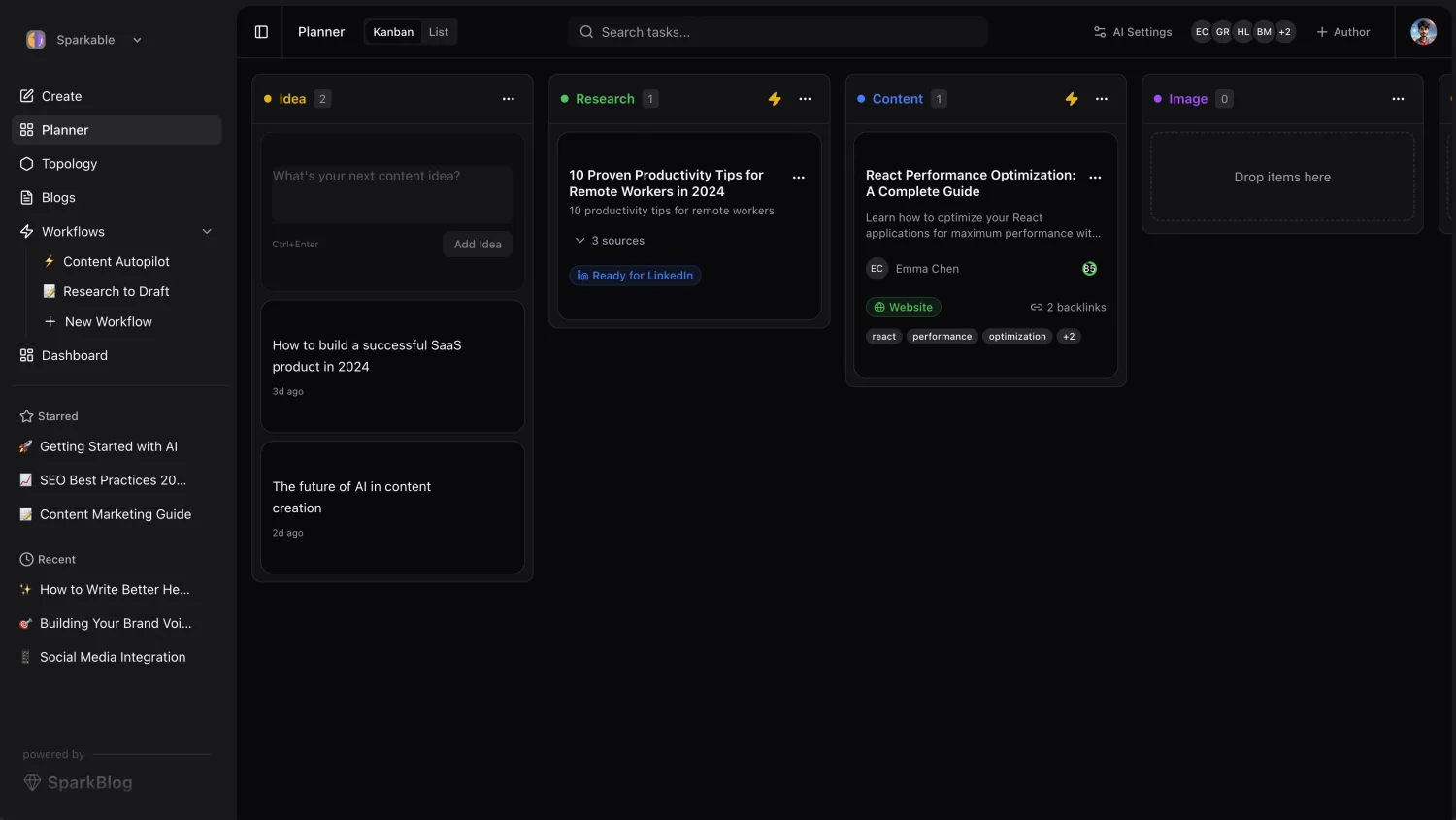
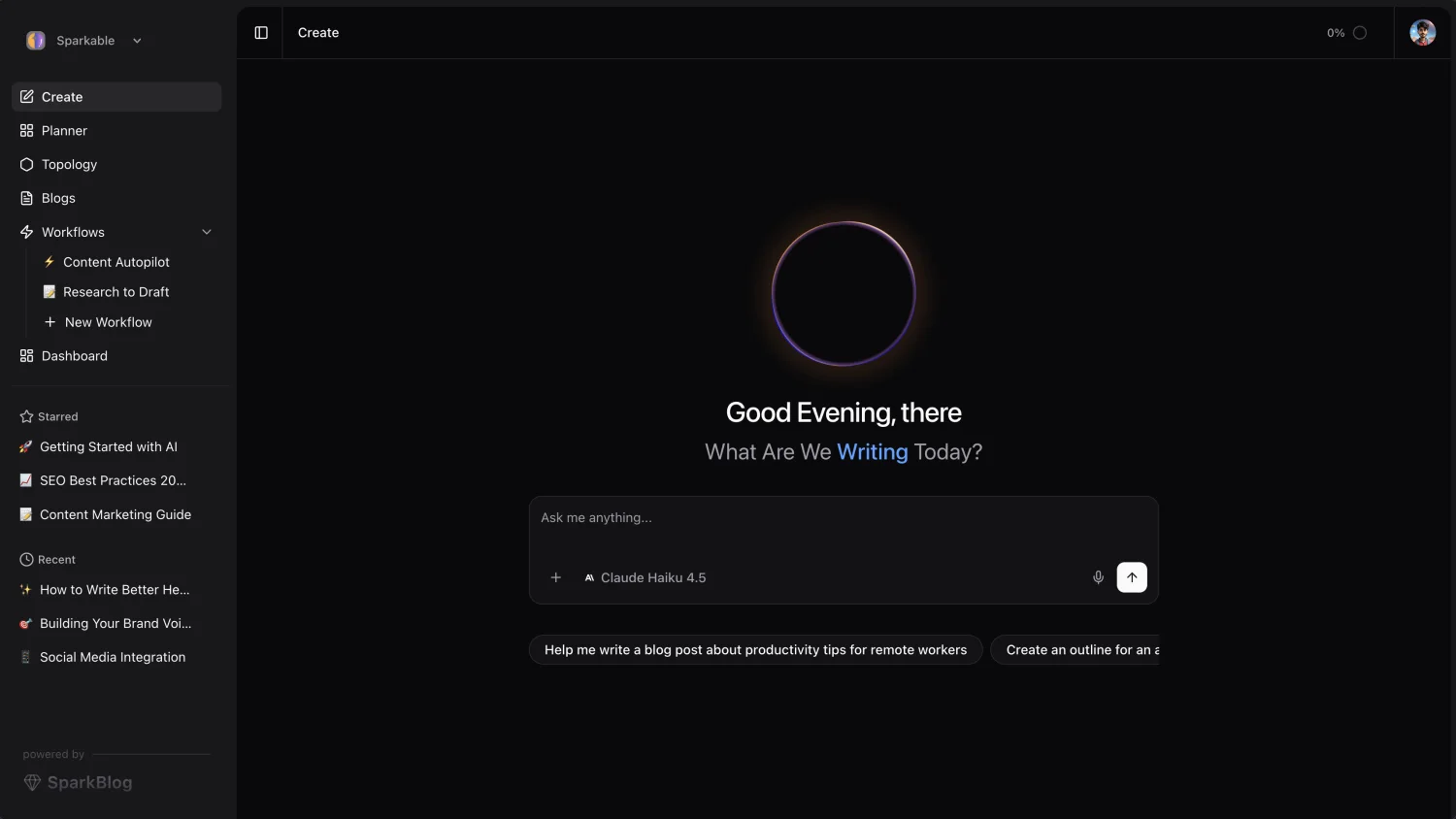
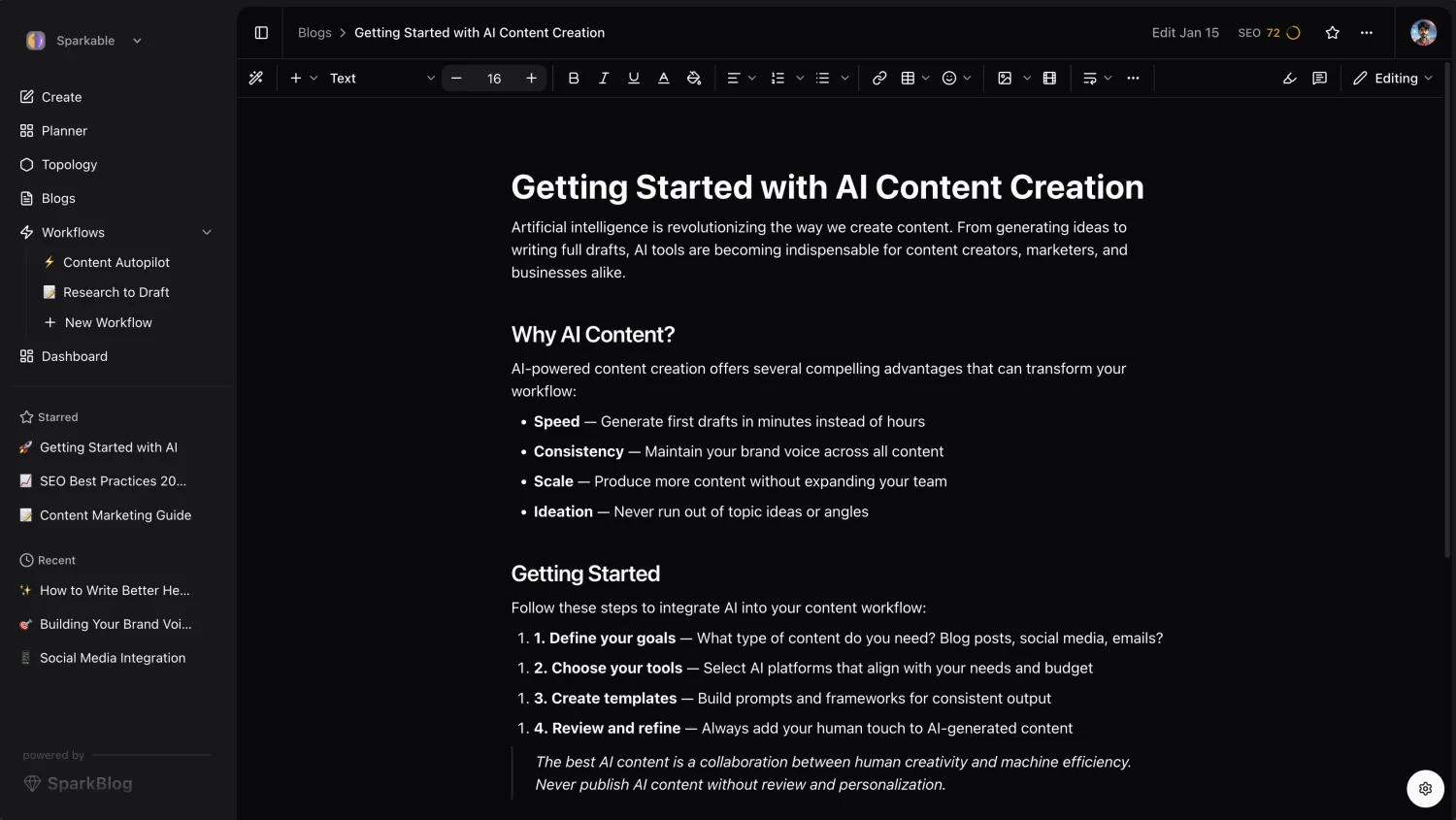
The whole thing is one pipeline with five stages: Idea, Research, Content, Image, and Review. You drop a half-formed thought into the Planner, something like "the real cost of HIPAA for telehealth startups," and it enters the estate. The research agent fans out across live sources and returns a cited brief, so you read one brief instead of twenty tabs. The content agent drafts from that brief with links placed inline, and the platform computes an SEO score across structure, readability, linking, and metadata. You review in a full editor with comments, versions, and AI edit commands like "tighten the intro," and only then does it ship.
Designing the estate, not a list
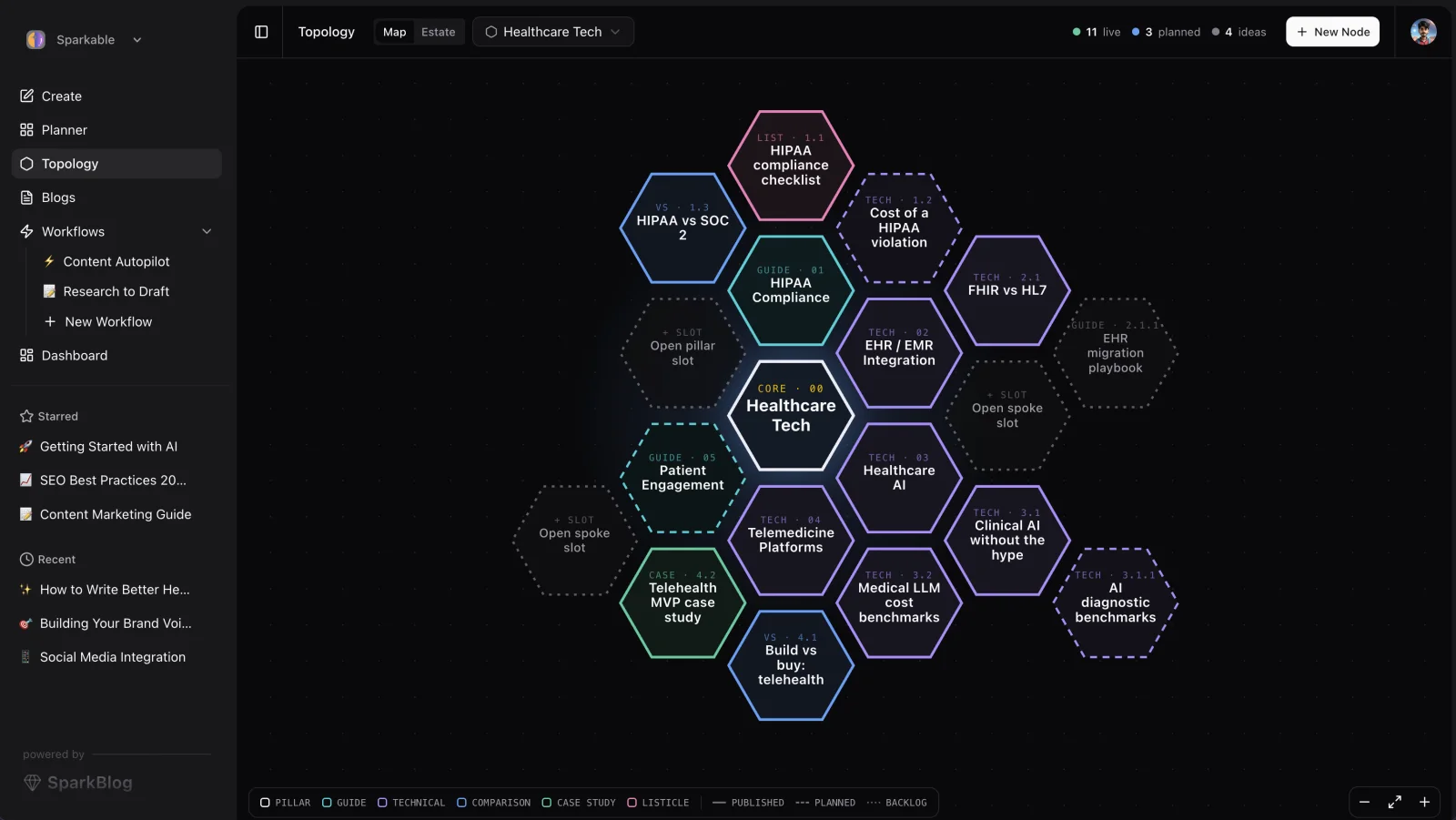
The piece I am proudest of is Topology. Most content tools show you a list of posts. SparkBlog shows you a honeycomb map of your whole content estate: the core pillar, the supporting spokes, the planned pieces, and the open slots where competitors are still winning. Strategy stops being theoretical. You can see the gap and fill it. Designing a view that makes an abstract idea, the shape of a content estate, feel physical and obvious was the most interesting design challenge in the product.
Under the hood
SparkBlog runs on TanStack Start with Convex as the single source of truth, the Vercel AI SDK orchestrating Anthropic, Google, and OpenAI models across the agent stages, and the Plate editor for the review experience. Chat is ephemeral by design and expires. If it matters, it lives in the database.
Where it is
SparkBlog is in private beta, waitlist-only and owner-approved, because the fastest way to a great enterprise product is a small group of serious users giving dense feedback, not a thousand tourists. The feeling I am building toward is a Monday morning where a team opens SparkBlog, sees exactly what the estate needs next, and ships two grounded, scored, reviewed articles by lunch.
Let's build something.
Have a product to ship or a project to scope? Let's talk.