SparkFrame
From ten styles and a prompt box to an idea first, agentic content engine.
Overview
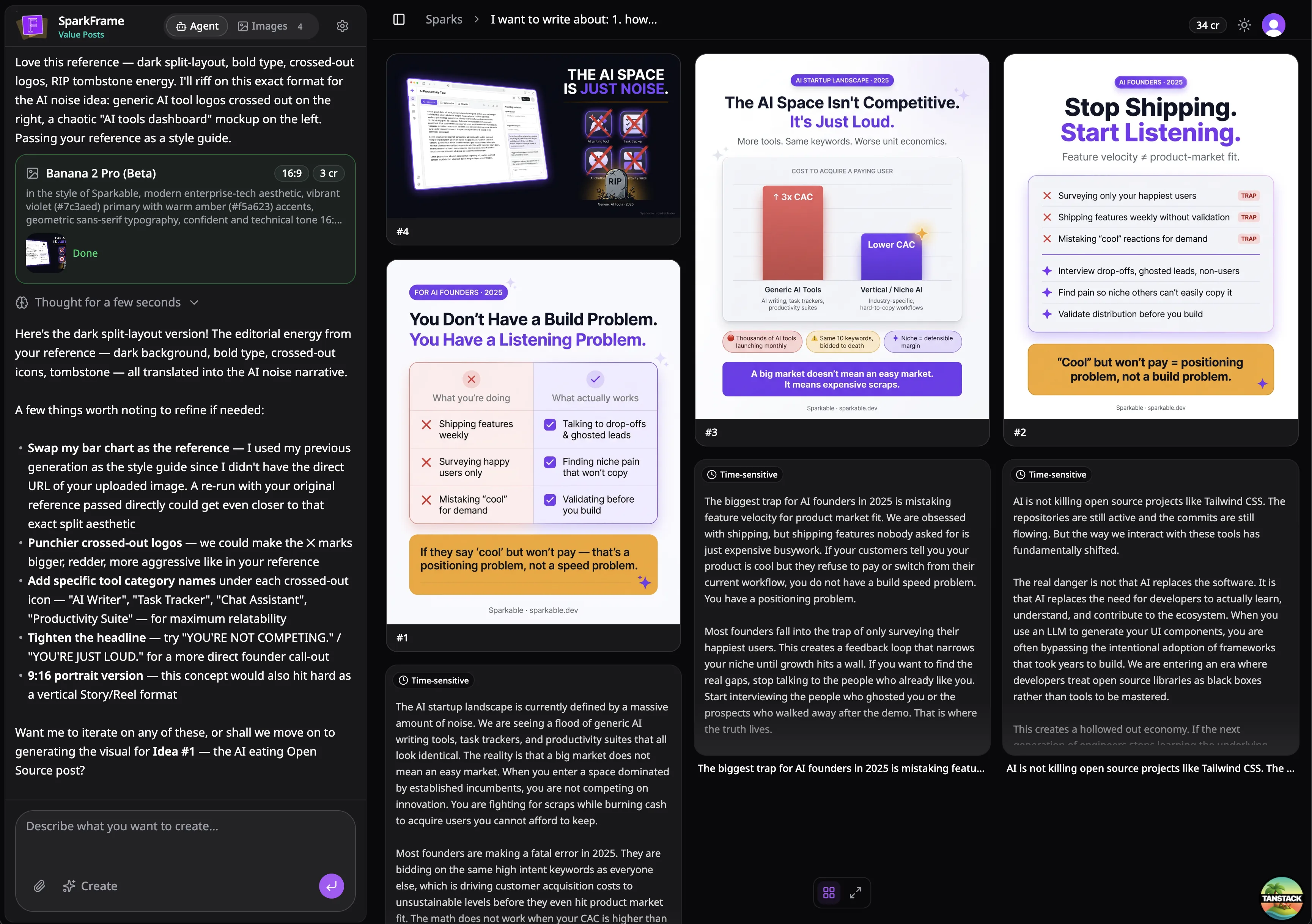
SparkFrame is an AI content platform for people who publish on LinkedIn and Twitter and run ads on Google and Meta. You start from a single idea, SparkFrame generates post concepts, turns the ones you like into branded visuals, and gives you a chat based agent to refine them until they are exactly right. No design skills, no template wrangling, no hours lost in Canva.
I am the founder, and I designed and built it end to end. What follows is the honest version of how it started and how far it has come.
Why I built it
About a year ago I started writing on LinkedIn. Real stories, lessons from building products, the mistakes I made along the way. For a while it worked. People resonated, and I was building genuine connections.
Then my reach started dying. Not because the writing got worse, if anything it got sharper, but because the algorithm had shifted toward visuals. I watched founders with half the substance get ten times the reach simply because they had a strong image attached to every post. I was losing reach because of how my posts looked on the feed, not because of what they said.
The research that convinced me
The frustration was personal, but the numbers were not just mine:
- Visual posts earn 2 to 3 times more engagement than text only posts, with more comments and more shares.
- Content with visuals gets up to 94% more views.
- The brain processes images roughly 60,000 times faster than text, and people remember far more of what they see than what they read.
- On paid social, the creative is the whole game. A strong offer with a weak visual will not move.
Great ideas were getting less reach than they deserved, and great products were getting fewer clicks than they should, purely because of how they looked. That gap is what SparkFrame closes.
Version one was small on purpose
I launched the first public beta on February 12, 2026. It was deliberately tiny: ten visual styles and a prompt box. Pick a vibe, get an image. That was the entire product.
It worked well enough that my posts started getting seen again, and well enough that the first wave of users told me exactly what was missing. It also taught me an early lesson: we launched as SparkPost, discovered an email company already owned the name, and became SparkFrame two weeks later. Ship fast, but trademark first.
Then I started listening
A pattern showed up immediately. Nobody wanted a single output. They wanted to compare, swap, and iterate. So I shipped two image generation pipelines side by side: a fast single shot one for when you knew exactly what you wanted, and an iterative one for when you did not. You could toggle between them mid session without starting over. Brand presets and persistence landed in the same release, because losing your work between tabs is its own kind of cruelty.
Then came the unglamorous but critical work: auth edge cases, cold starts, rate limits, orphaned asset cleanup. None of it is exciting to talk about. All of it is the difference between a tool people try and a tool people use.
From a tool into a platform
By mid April the most common request was the same: can I use this for ads too? A real chunk of early users were running Google and Meta ads, and the gap between posting and advertising did not make sense to them. Same brand, same voice, same designer-less reality, so why two tools?
So SparkFrame grew up into three full content modes, 80 templates in total:
- Storytelling, 19 templates: comic strips, newspaper layouts, concept art, before and after, bold quote cards.
- Value Posts, 21 templates: data dashboards, frameworks, checklists, timelines, charts, decision trees.
- Creative Ads, 40 templates: headline ads, testimonials, social proof, comparison grids, offer bursts, UGC styles, scroll stoppers.
Brand DNA from a URL
Setting up a brand used to mean filling out forms. Now you drop in a URL and SparkFrame reads your site, then extracts your colors, voice, products, style, and even the founders and authors behind the brand. About fifteen seconds, end to end. You can edit anything you do not like, but most people never have to. Every visual you generate stays consistent with that Brand DNA, so your content always looks like it came from the same place.
Going fully agentic
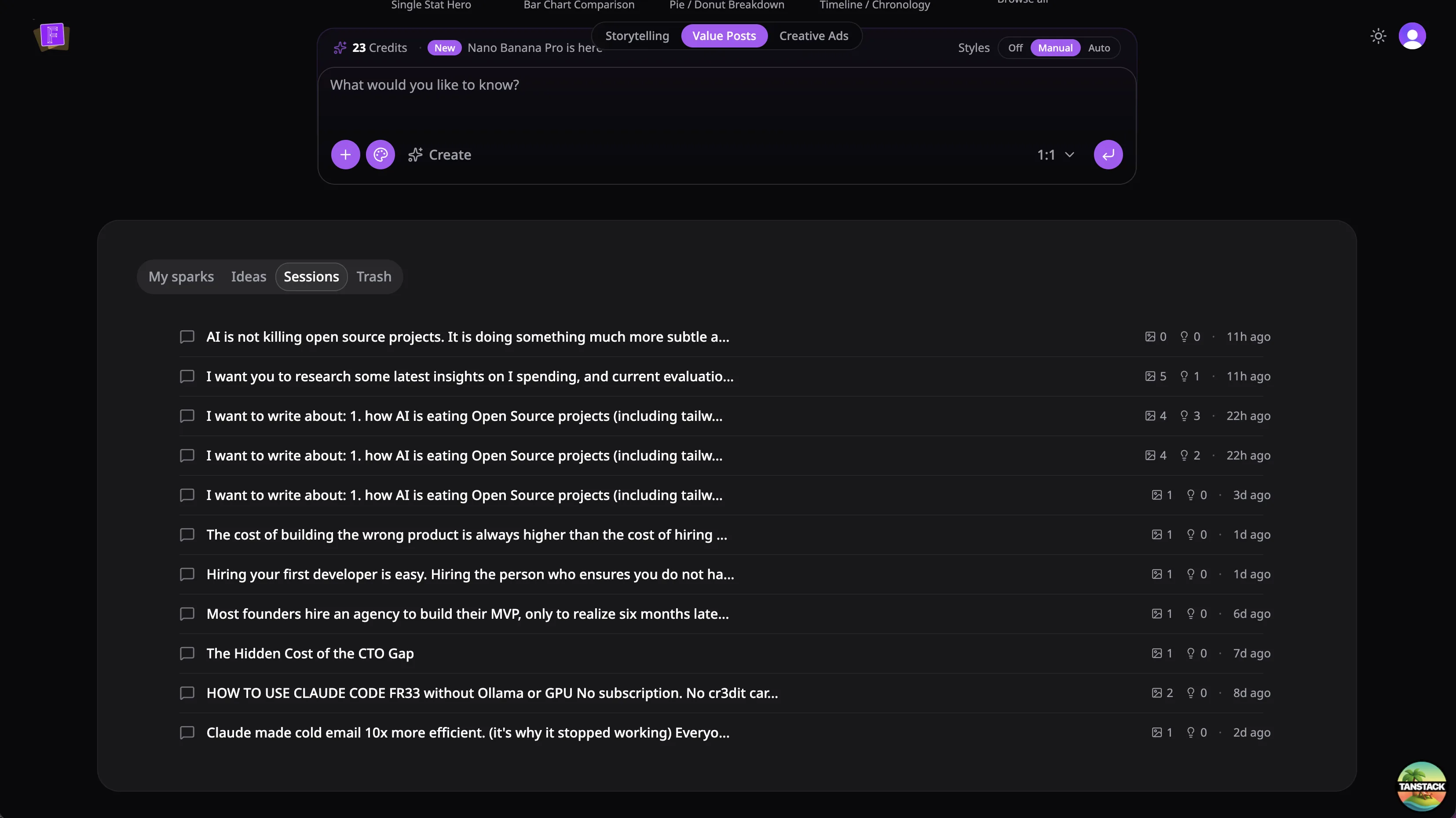
On May 8 I made a decision that felt risky at the time. I deleted the old manual modes entirely and replaced them with one agent and one workflow. No more deciding which mode to use. A chat based agent now sits next to the canvas, picks the right model for the job, runs the generation, and iterates with you in plain language. It is the version of AI people actually want: not a settings panel, just a thing that does the work.
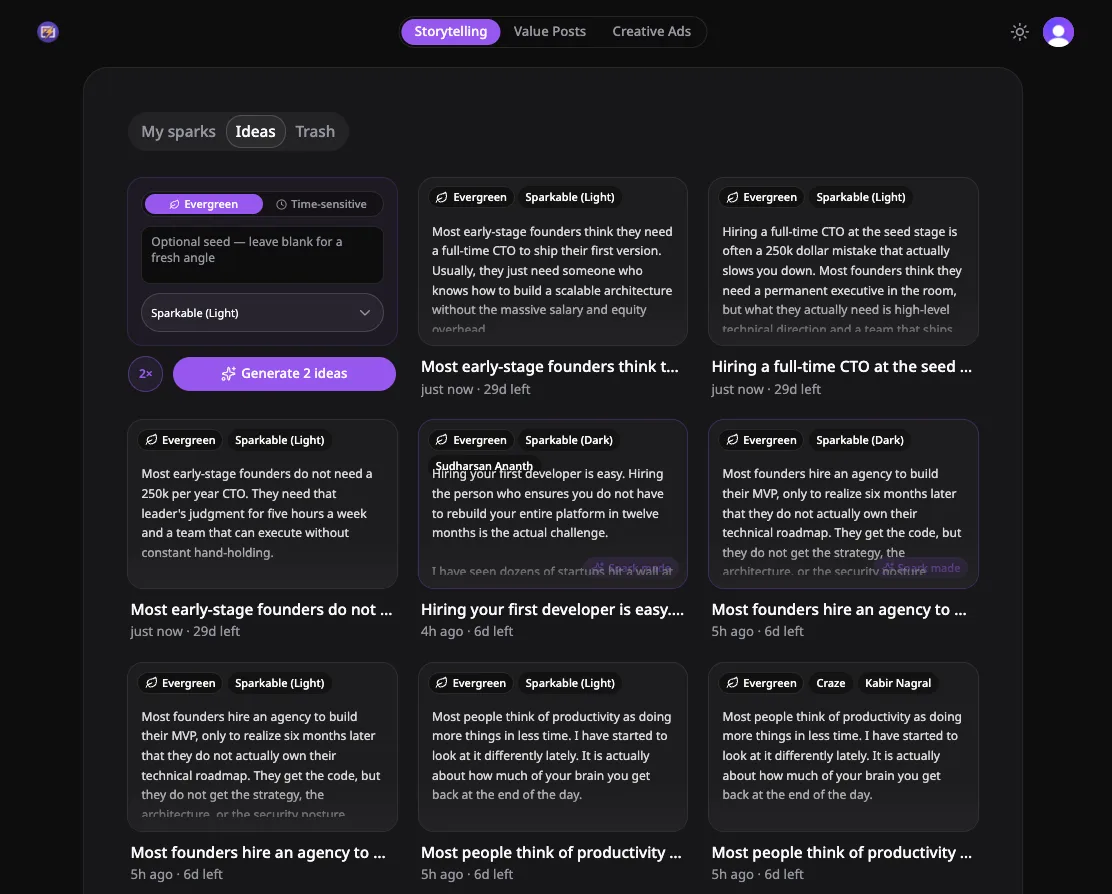
The last missing piece was the hardest half of the problem. Generating the visual was never the real bottleneck. Getting to the idea in the first place was. So I built the Ideas pipeline: give SparkFrame a topic and it generates a batch of post concepts, evergreen or time sensitive, one, two, or four at a time. You read them, edit the one you like, and promote it into a visual with a single click.
Where it is now
Three months after a prompt box and ten styles, SparkFrame is a platform you can run an entire content operation on, without a designer:
- Idea first: start from a prompt, not a finished post.
- 80 templates across Storytelling, Value Posts, and Creative Ads.
- Brand DNA from a URL, with founder and author detection.
- A chat based agent that chooses the model, runs the generation, and refines with you.
- One workflow for organic and paid: LinkedIn, Twitter, Google Ads, Meta Ads, and CTA visuals, with exports up to 4K.
What I took from it
SparkFrame started as a fix for my own dying reach and turned into a product whose roadmap was written by its users. Every major leap, the ads category, the URL based setup, the Ideas tab, came from someone telling me what they actually needed. I just kept listening and shipping.
It is in early access now, with 100 free credits on signup and early pricing locked in for life. We are just getting started.
Let's build something.
Have a product to ship or a project to scope? Let's talk.